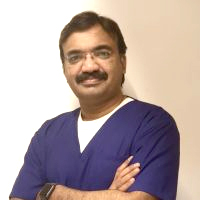
Dr Muralikrishna Nekkanti

dr-muralikrishna-nekkanti

Dr Muralikrishna Nekkanti has over a decade experience in vascular surgery with a specific focus and passion for aortic aneurysm management and scarless endovenous management of varicose veins. Dr Muralikrishna completed his MBBS in 2002, MS General surgery in 2006, and DNB Peripheral Vascular and Endovascular surgery in 2009. Apart from thse, Dr Muralikrishna has a fellowship in advanced vascular and endovascular surgery from the prestigious Paracelsus Medical University, Salzburg, Austria. Dr Muralikrishna was instrumental in the establishment of the Department of Vascular Surgery at the Sri Jayadeva Institute of Cardiovascular Sciences as well as Rangadore Memorial Hospital. Dr Muralikrishna specializes in arterio-venous fistulas for dialysis patients apart from the entire range of vascular procedures and management. Dr Muralikrishna’s research interest is in stem cell therapy leading to national and international publications, conference presentations and posters. Currently Dr Muralikrishna works as Professor and Head of Vascular Surgery Department at Sri Jayadeva Institute of Cardiovascular sciences.

Dr Vimal Iype

Vascular and endovascular surgeon trained and experienced in dealing with vascular ailments commonly varicose veins,dvt,peripheral arterial occlusive diseases(POAD), Aneurysms, carotid stenosis , dilaysis access solutions.Has experience in all modalities of treatment – open and endovascular .with over 12 years experience at a high volume centre .

Arterio-Venous FISTULA [AVF]

A vascular surgeon performs arteriovenous (AV) fistula surgery. A vascular surgeon specializes in surgery of the blood vessels.

The goal is to allow high blood flow so that the largest amount of blood can pass through the dialyzer. The AV fistula is a blood vessel made wider and stronger by a vascular surgeon to handle the needles that allow blood to flow out to and return from a dialysis machine. Most people can go home after outpatient surgery.

An A-V fistula usually takes 4 to 6 weeks to be ready before it can be used for haemodialysis. The fistula can be used for many years. A graft (also called an arteriovenous graft or A-V graft) is made by joining an artery and vein in your arm with a plastic tube.

As with all surgeries, arteriovenous (AV) fistula surgery involves risks and potential complications. An AV fistula generally lasts longer and has fewer complications than other dialysis access options, such as a venous catheter or AV graft. Complications are still possible and may become serious or life threatening in some cases.

Complications can occur during surgery, throughout your recovery, or later after the AV fistula has been used for years of dialysis.

Stenosis and thrombosis are the most common complications of AV fistulas. Central vein stenosis occurs in 19-41% of HD [Haemodialysis] patients. Patients presenting to the ED [Emergency Department] with fistula stenosis may report distress secondary to upper extremity and chest wall oedema [swelling].

A vascular surgeon usually performs the procedure in the operating room. You receive a local anaesthetic (numbing medicine) at the proposed site  sometimes along with IV sedation to relax you]. Discomfort is minimal and you may even fall asleep during the 1 to 2 hour-long
procedure.

The creation of an arteriovenous fistula (AVF) for haemodialysis access is a low-risk procedure. It is often time sensitive, as one can avoid use of central venous catheters (CVCs) and their complications.

An AV graft is a looped, plastic tube that connects an artery to a vein. A vascular surgeon
performs AV graft surgery, much like AV fistula surgery, in an outpatient center or a hospital.
The patient may need to stay overnight in the hospital, although many patients can go home after the procedure. A health care provider uses local anaesthesia to numb the area where the surgeon creates the AV graft.
A patient can usually use an AV graft 2 to 3 weeks after the surgery. An AV graft is more likely than an AV fistula to have problems with infection and clotting. Repeated blood clots can block the flow of blood through the graft. However, a well-cared-for graft can last several years.

All types of vascular access—AV fistula and AV graft - can cause problems that require further treatment or surgery. The most common problems include access infection and low blood flow due to blood clotting in the access.
Infection and low blood flow happen less frequently in properly formed AV fistulas than in AV grafts. Still, having an AV fistula does not guarantee the access will be problem-free.

AV grafts more often develop low blood flow, an indication of clotting or narrowing of the access. The AV graft may then require angioplasty, a procedure to widen the narrow part.  Another option involves surgery on the AV graft to replace the narrow part.

A patient can care for and protect a vascular access by:
• Ensuring that the health care provider checks the access for signs of infection or problems with blood flow before each haemodialysis treatment.
• Keeping the access clean at all times.
• Using the access site only for dialysis.
• Being careful not to bump or cut the access.
• Checking the thrill in the access every day. The thrill is the rhythmic vibration a person can feel over the vascular access.
• Watching for and reporting signs of infection, including redness, tenderness, or pus.
• Not letting anyone put a blood pressure cuff on the access arm.
• Not wearing jewellery or tight clothes over the access site.
• Not sleeping with the access arm under the head or body.
• Not lifting heavy objects or putting pressure on the access arm.

AV fistula surgery can improve the comfort and quality of life for people who need long-term dialysis. An AV fistula is the preferred method of vascular access for long-term dialysis. It generally lasts longer and has fewer risks and complications than other access methods, including venous catheters and AV grafts.

It is important to keep your follow-up appointments after surgery. Contact your doctor for questions and concerns between appointments. Call your doctor right away or seek immediate medical care if you have:

• Bleeding
• Breathing problems, such as shortness of breath, difficulty breathing, labored breathing, or wheezing
• Change in alertness, such as passing out, dizziness, unresponsiveness, or confusion
• Chest pain, chest tightness, chest pressure, or palpitations
• Fever. A low-grade fever (lower than 101 degrees Fahrenheit) is common for a couple of days after surgery and not necessarily a sign of a surgical infection. However, you should follow your doctor's specific instructions about when to call for a fever.
• Leg pain, redness or swelling, especially in the calf, which may indicate a blood clot
• Loss or change in the pulse in the AV fistula
• Pain that is not controlled by your pain medication
• Unexpected drainage, pus, redness or swelling of your incision

Dr. Sunil Rajendran

Dr. Sunil Rajendran, MS, DNB, MRCS (Edin), PDCC (SCTIMS) Senior Consultant Vascular Surgeon In Kerala Education Dr. Sunil Rajendran did his MBBS form Calicut Medical College and MS in General Surgery in 2002. He cleared DNB (Diplomate of National Board) in 2005. He did his Post-Doctoral Fellowship in Vascular Surgery from Sree Chitra Tirunal Institute of Medical Sciences (SCTIMST), Trivandrum in 2005. He was admitted as Member of National Academy of Medical Sciences (MNAMS), New Delhi in 2005 and as Member of Royal College of Surgeons (MRCS) of Edinburgh, UK in 2006.’